|
Return to Front Page
John's Corner
The standard Phonetic Alphabet is used by police, emergency services, military and paramilitary organisations, especially in radio or telephony communications, to clearly distinguish characters and virtually eliminate misinterpretations. Both letters and numbers are specified. The stated pronunciations, emphasis and spellings are part of the standard and should not be altered.
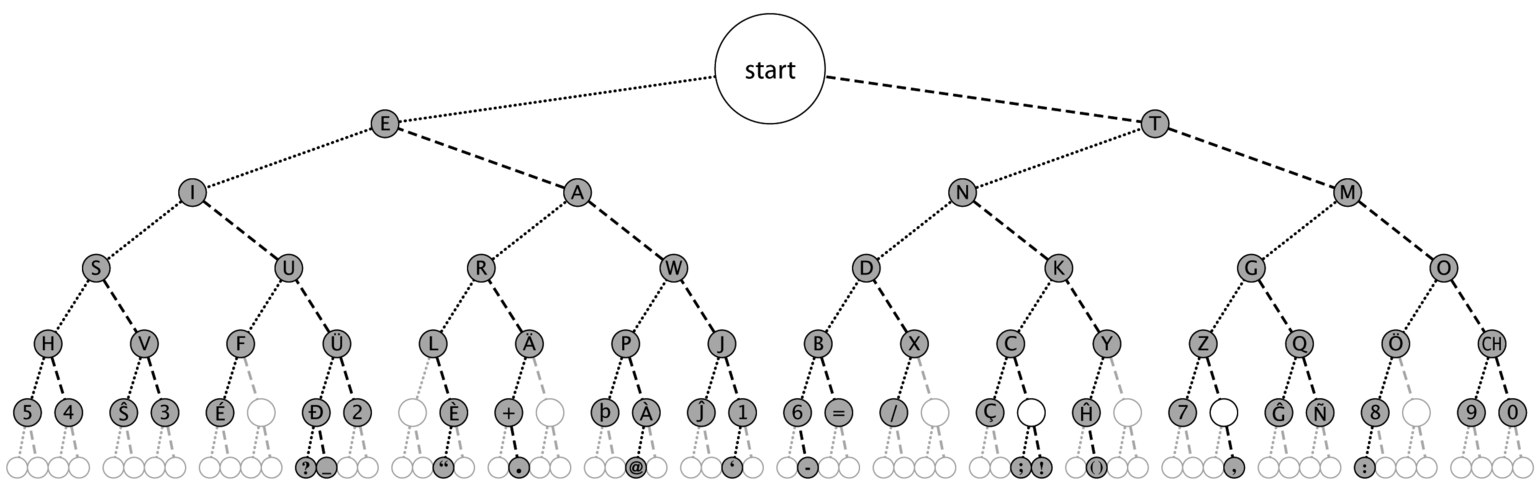
The Morse Code representations are also shown in the table below. Morse is a binary code that uses sequencess of a • (dot spoken as "dit") and a − (dash spoken as "dah") to represent letters, numbers and spaces. The number of dots and/or dashes is variable. Letters use up to four dots and/or dashes. The most common letter "E" is represented as a single •. A less common word such as "Q" is represented as − − • −. Numbers are represented as combinations of 5 dots and dashes.
The timing of transmission is based on the duration of a dot, which represents one "unit" of time, as follows
| • (dot or "dit") | 1 unit |
| − (dash or "dah") | 3 units |
| intra-character gap (within a character) | 1 unit |
| short gap (between letters) | 3 units |
| medium gap (between words) | 7 units |
A dot duration of 60 milliseconds (msecs) translates to an average speed of 20 words per minute. This is based on sending the standard word "PARIS" 20 times in succession. PARIS is intended to represent a typical natural language word and requires 50 units to send with standard spacing as above. This would take 3000 msecs (3 secs) to send once, or 6000 milliseconds (60 secs or 1 minute) to send 20 times.
|